 Actions Therapy
Subtle School Bullying
Subtle School Bullying
Subtle School Bullying
Subtle School Bullying
Subtle School Bullying
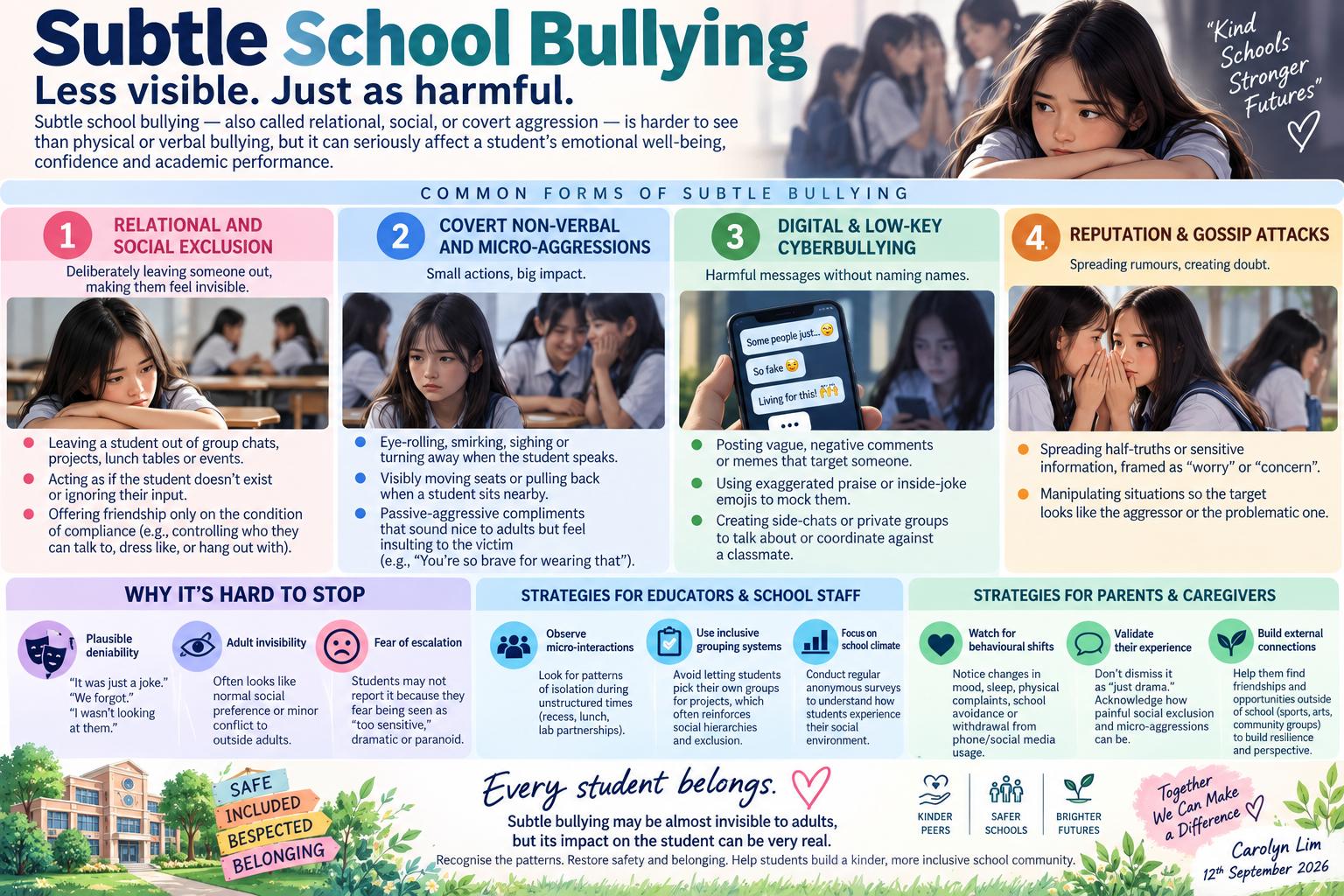
Subtle school bullying—also called relational, social, or covert aggression—can be difficult to see because it often happens through social exclusion, gestures, gossip, or digital interactions rather than direct physical or verbal attacks. Despite being less visible, it can seriously affect a student’s emotional well-being, sense of belonging, confidence, and school performance.
It commonly appears as deliberate exclusion, ignoring someone, conditional friendships, eye-rolling or smirking, distancing behaviours, backhanded compliments, indirect social-media attacks, secret group chats, rumours, and manipulating situations so that the targeted student appears to be the problem.
What makes subtle bullying particularly difficult is plausible deniability. Behaviours can be dismissed as “just joking,” “forgetting,” or ordinary friendship preferences. Students may also hesitate to speak up because they fear being seen as overly sensitive or making the situation worse.
Effective intervention therefore focuses less on isolated incidents and more on repeated patterns and power dynamics. Educators can observe social interactions, use inclusive grouping practices, and monitor the overall school climate. Parents and caregivers can notice changes in mood, sleep, physical complaints, school avoidance, or social withdrawal, while taking the young person’s experience seriously.
Key message:
Subtle bullying may be almost invisible to adults, but its impact on the student can be very real. The goal is not simply to determine who is “right” or “wrong,” but to recognise harmful relational patterns, restore safety and belonging, and help students develop healthier ways of relating to one another.
Carolyn Lim
11th September 2026